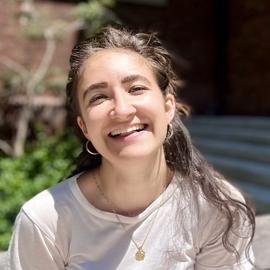
I am a fourth-year PhD candidate in computational neuroscience at the M-Lab of Adaptive Intelligence (EPFL, Switzerland). My research lies at the intersection of machine learning and neuroscience, where I develop data-driven models to study and replicate how biological and artificial agents actively seek information in complex and uncertain environments. I work on representation learning, contrastive methods, and time-series analysis of high-dimensional behavioral and neural data. A key focus is understanding how vision and movement interact to support adaptive decision-making.
Beyond neuroscience, I am broadly interested in applications of machine learning to real-world problems — from intelligent systems and robotics to health and brain–computer interfaces. As my PhD progresses, I am extending my work to reinforcement learning, combining behavioral modeling and neural representations to study active information-seeking and adaptive strategies.
- Computational Neurosciences
- Artificial & neural intelligence
- Contrastive & Representation Learning
- Motor Control, Vision & Learning
- Time-Series & High-Dimensional Data
PhD in Electrical Engineering (ELLIS Society PhD Fellow; EPFL PhD Excellence Fellow), Present
EPFL
MSc in Computational Sciences & Life Sciences Engineering (EPFL-WISH Foundation Fellow), 2022
EPFL
BSc in Life Science Engineering, 2019
EPFL
Experience
- Develop novel representation learning methods for large-scale biological time-series, resulting in Unified CEBRA, a framework for integrating neural recordings across experiments (under review).
- Led the development of an augmented-reality platform combining game engine, hardware and behavioral experiments, coordinating a 20-author collaboration across three laboratories (Benquet et al. 2026).
- Mentored 6 MSc and semester students, providing technical guidance on machine learning and software development.
- Core contributor to CEBRA, an open-source machine learning framework (Nature, 2023, +1000 GitHub stars).
- Developed new model architectures, data management & inference pipelines, reproducible API, and software structure.
- Compared latent representations in recurrent neural networks and biological neural populations during decision making to study biological computation.

- Evaluated machine learning algorithms for ECG and PPG signal quality assessment to improve a wearable cardiac monitoring device.
- Designed and benchmarked anomaly detection pipelines on clinical and synthetic datasets, comparing supervised and density estimation approaches.
- Built reproducible evaluation pipelines and introduced application-specific performance metrics to balance clinical safety, data availability, and computational efficiency.
Open-Source Contributions
- CEBRA (1000+ stars): Core contributor. Developing model architectures, inference/data pipelines, and reproducible API for a widely-used open-source representation learning framework for biological time-series analysis.
- FreelyMovingVR4Mice (related to Benquet et al. 2026): Core contributor. Developing an open-source software framework integrating Unity, behavioral control, and hardware interfaces for freely moving virtual reality experiments in mice.
- CEBRA-lens (under active development): Core contributor. Developing a Python library for mechanistic interpretability of CEBRA models.
Skills
PyTorch, scikit-learn, pandas, gymnasium
Representation learning, contrastive learning, time-series modeling, latent variable models
Neural data analysis (NWB, DANDI), image/signal processing, high-dimensional data visualization
Git, CI/CD, Docker, package development, reproducible APIs
C++, Java, MATLAB, SQL
Computational neuroscience, vision, learning and decision-making
Talks & Posters
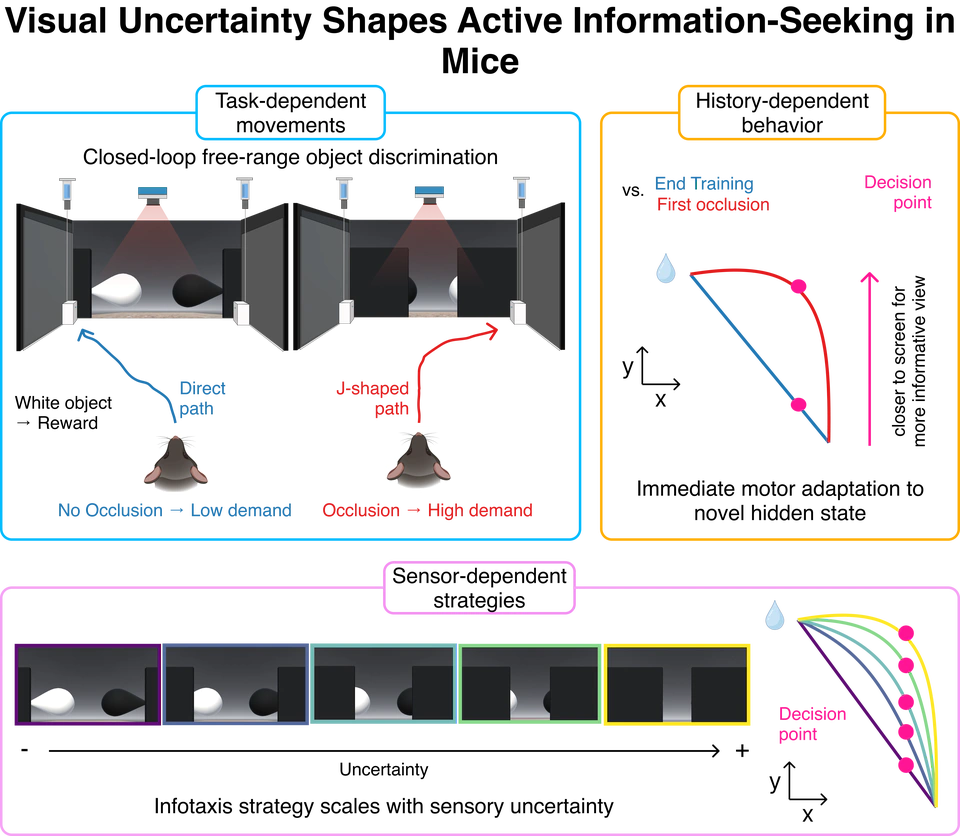
- Talk - EPFL SV Faculty Seminars Series 2026: Visual uncertainty and task demands shape active sensing strategies in mice.
- Talk - Nature in Code Summer School (EPFL Education & Science Outreach): Decoding the brain: from starry skies to neural codes.
- Poster - Swiss Society for Neuroscience Annual Meeting 2025: A Unified Encoder for Modeling Neural Dynamics with Contrastive Learning (Benquet, Mirzaei, Schneider, Mathis).
- Poster - Swiss Society for Neuroscience Annual Meeting 2025: An augmented reality system to study active visual sensing in dynamically occluded environments (Benquet, Sainsbury, Cai, Fahey, Franke, Franco, Pitkow, Niell, Tolias, Mathis).
- Poster - Neuro-X Retreat 2024: An augmented reality system to study active visual sensing in dynamically occluded environments.
Teaching
- System Neurosciences, EPFL: teaching assistant for Master’s course (Prof. Mackenzie Mathis); course design support, journal clubs, student guidance, and exam review/proctoring.
- Basic Neurosciences, EPFL: teaching assistant for third-year Bachelor’s course (Prof. Mackenzie Mathis, Prof. Pavan Ramdya); exercise-session support and exam review/proctoring.
- Basic C++ and Algorithms, EPFL: teaching assistant for first-year Bachelor’s students; exercises, conceptual support, and Piazza/Zoom assistance.
- Complex and Vectorial Analysis, EPFL: teaching assistant for second-year Bachelor’s students; exercises, conceptual support, and Piazza/Zoom assistance.
- Thermodynamics and Relativity, EPFL: teaching assistant for first-year Bachelor’s students (Prof. Ivo Furno); exercises, mock-exam correction, and student support.
Interests
Marathon, semi-marathon, trails
Hiking, skiing, climbing
Sailing, kite-surfing, scuba-diving